
Her father a gravedigger on the outskirts of Guthrie, Oklahoma. Mother an oilfield prostitute. At least that was Carla’s story whenever the topic of David’s grandparents came up. The details at once consistent and largely uninformative. Carla’s father sinewy, bald, unshaven, one front tooth cracked, in workman’s overalls and grime reliably under each fingernail. Regarding the mother, no further particulars, except that she was taller than her gravedigger husband, and had the beaked nose of a parrot. How lovely, David thought, imagining the grandparents he had never known.
Now years and miles from Guthrie. Carla an old woman. David in the ER with Carla, kitty corner from each other. Carla with an exacerbation of her emphysema, oxygen mask on, breathing treatments ordered. From where David lay in the emergency room exam bay, he could see her lower legs. The oval patch of gray, sunken skin on her left calf, which to David had always looked like burned flesh, glistened wetly in the overhead light. A birthmark, Carla insisted of the disfigurement, adding that some folks are born scars in place and prepared for the world. On her gurney, Carla’s feet splayed in opposing directions, frayed pink socks dangling.
“Mom!” He called.
Carla wriggled her toes.
David started to sit up, but a stabbing pain in his right flank stopped him, and he lay back with a groan.
* * *
A torrential downpour earlier that afternoon, the porch of Carla’s house soaked, rivulets of water streaming down the short walkway to his car. Carla too weak to walk, her breathing raspy, face pinched and pale from the effort to inhale, a bout of emphysema worse than David could recall. He had come home from his job at the cigar shop to find her in this condition. When he asked if she had tried her inhalers, she nodded, gasped yes. What he should have done was call 911. What he did instead was carry Carla in his arms out the house, with the plan to drive her the short distance to the hospital. He didn’t get them very far. His legs slipped from under him on the drenched porch, Carla’s arms still clinging to his neck as they both fell, her slight form half-spinning away, so that they landed at right angles to each other, her body half over his, his face touching her damp, cold cheek.
“You OK, Mom?” David croaked.
Carla pondered him. Nodded calmly, as if all this was exactly what she anticipated the moment David scooped her up. Amazingly, her breathing seemed steadier now. The fall dislodging some serpiginous slug of mucous from her bronchial tree, opening up an occult passage for oxygen to filter through.
He tried to lift himself off the porch, but the combination of pain and lack of traction on the wet ground kept David where he was. The street was empty except for a smattering of green, black and blue waste bins lining the curb in anticipation of the garbage truck. The rain coming down hard. He fished in his shirt pocket for his cellphone. It was still there. Called 911.
* * *
He had settled into his mother’s modest 2-bedroom, 1.5-bathroom bungalow on the outskirts of Fremont, California nearly 3 months before. Packed his belongings in a suitcase and a single duffle bag, and moved out of his studio apartment one town over. For the floundering musician in David, timing was the ballast, the unfaltering metronome swinging in his brain, on and off the stage. Whether behind the drum set or keeping Carla out of the hospital, it was all about time, timing, cadence. Fluid and polyrhythmic, but also unforgiving of any misstep—a rushed stroke on the snare, a delayed push on the kick. Any perturbation outside of a channeled rhythm as jolting as a sudden air pocket in flight. And apart from this recent misfortune, David had managed to avoid having to bundle Carla to the ER at Hillside Community Hospital, a few blocks from their home. Part of the plan—the moving in with Carla plan—was to be there in time to avoid the ER. To intervene at precisely the right moment, and circumvent in some way the vortex of age and disease. The ER was loud. It had an odor of something damp and moldy. It was always busy. It was humanity stacked upon itself in layered misery. Maybe only the DMV could compare. Or prison. Except David had never been to prison.
David knew that this arrangement was understood very differently by Carla. As she saw it, David’s move had nothing to do with caretaking. She would say—as she did every opportunity she could to anyone who would listen—that David was a struggling musician who worked in a cigar shop. No reason a struggling musician should have to bear unnecessary expenses. Why exacerbate hardship? What else is a mother for but to be there in her son’s time of need? Why waste an empty bedroom that a fully grown, adult son could use? What sense would that be?
At Carla’s regular clinic visit the month before, and prompted by the doctor’s inquiry into how Carla was coping at home by herself, David said, “I moved in to help out as much as I could. I work full time. But being there when I can, makes me feel better.”
Carla—eyes steady on the doctor, an attractive middle-aged woman, white coat, hair in a bun, elegant brown-framed glasses, perfectly put together, no wedding band—quipped, “David also plays the drums in a band. You may have heard of them. Or maybe not. P.O. Box 66. Maybe not. They play where they can. P.O. Box 66. Check them out.” Then she turned to David and said, “Where are you playing next, David? Maybe Dr. Grace would like to come and listen?”
David smiled awkwardly, touched the wrinkled, diaphanous skin of Carla’s hand. “I’m sure the doctor has better ways to spend her free time.” Then, against an erupting sense of inadequacy, he added, “It’s a local band. We play most nights around town. Different places.” He skipped mention of the last gig. The one at the Saint Elouise’s Junior High School Fall Blowout, although it paid better than most.
* * *
They passed each other on gurneys back and forth from the exam bay to the X-ray Department. Carla propped up against the raised back of her gurney, draped in a white sheet, one end tucked under her neck. Calm, even regal in demeanor, despite the nasal cannula blowing oxygen into her lungs, and her gray hair spiking madly. She peered into the jaundiced light of the emergency room, her blue eyes aloof and unblinking. David in a fetal position on his way to an X-ray, whimpering as the gurney hit a dent on the tile floor. Nothing close to regal.
X-rays all clear for David and Carla. A shot of Toradol in David’s backside to ease the pain. Two breathing treatments for Carla followed by vehement admonitions about smoking from the emergency room doctor. The poor man inflamed and agitated in his crumpled white coat.
“A bad habit Ms. Fuller. A very bad habit,” he barked, so loudly that David, now seated in a chair by Carla’s gurney, was sure the entire groaning ward of patients could hear. HIPAA be damned.
Carla, it seemed, listened patiently. “I am moved by your concern, doctor,” she said gently as if to soothe the doctor’s distress. “I will do better.”
David was glad he had omitted his cigar smoking from his intake history. Not every vice needed to be revealed.
Orderlies rolled them in wheelchairs to the front entrance of the emergency room for their Uber ride home. Carla sat next to David in the back seat. Past two in the morning. Eight hours in the emergency room. The rain had ceased, but the empty road still wet and shimmering under the streetlights. The Uber driver played some forlorn foreign-sounding music out of his car stereo, turned and asked if that was OK.
David gave him the thumbs up. “Where’s that music from?”
“Afghanistan,” the driver said.
Carla said, “My son is a musician, you know.”
The Uber driver regarded David in the rearview mirror. Nodded an acknowledgement.
David patted Carla’s knee, passingly grateful for the recognition sans the usual colorful commentary. “Well, we made it,” he said to Carla with a tired smile.
They drifted past a 24/7 Walgreens. Two cars idled like desperate, lonely creatures in the shadows of its drive-through. On Paseo Padre Avenue, David eyed the darkened fronts of a hamburger joint and a pizza parlor, both of which stirred a hunger in him.
“There’s plenty of food at home,” Carla said.
The Uber dropped them off alongside their tidy front lawn. David crawled out of his seat, moaned as he humped his way around to open the door for Carla, who for a moment sat unmoving.
“Mom?” David said. Only then did Carla stir, shrugging off whatever reverie was occupying her. She clutched David’s offered arm, jack-knifed herself out of the car and onto the street. David grimaced as she bore her weight down on his arm. A pained smile and last wave to the Uber driver. The two of them watched as the car cruised down the darkened street. Taillights receded then disappeared as the car rounded a corner.
Carla held onto David’s arm, leaned into him, each step triggering a spasm in David’s back. At the front door he rummaged in his jacket pocket for the house keys, groped in the dark to slip key into lock. Finally succeeded, pushed the door open, reached for the indoor switch, and flipped the foyer light on. He groaned one more time as Carla bore her weight down on his arm and pushed herself ahead of him into the house.
“Good Lord,” muttered Carla at his fumbling efforts, and stepped past him.
“I can make us something to eat,” David called after her.
“That would be a good idea,” Carla said, before closing her bedroom door behind her.
A hot shower, Bengay and two Tylenol eased David’s pain to a tolerable throb. At the stove David cracked six eggs into a blotchy white ceramic bowl, added milk, whipped everything into a rich lather, poured the contents into a saucepan, butter sizzling, and threw in strips of American cheese. He slid his creation onto a steel platter, then walked a tray with the platter, two plates, utensils, salt and pepper shakers, a stack of paper towels and two cans of Coors beer into the sunroom at the back of the house.
“Food’s ready,” he announced loudly as he passed by Carla’s room.
When she didn’t answer, he set the tray down on the coffee table, knocked on her door. Getting no response, he gently turned the knob. Carla in bed, curled under the sheets, fast asleep. David dimmed the lights, closed her door, settled himself in his recliner and reached for the first of the beers.
* * *
A little before 9 a.m. David heard Carla shuffle out of bed, the wood floor of her bedroom creaking under her feet. She emerged in her lavender terrycloth robe, and stood at the threshold of the kitchen, an air of bafflement. At age 76, Carla’s sleep pattern spanned the course of the day in erratic bursts. If there was any thread of regularity it seemed to present itself in the morning. She would rise on hearing him in the kitchen with the sound of the coffee grinder. They started the day together with coffee in the sunroom, which also served as their smoking room, its spread of windows overlooking the small backyard—a few feet of patio, a patchy sickle of grass edging the wood fence which separated Carla’s house from her neighbors. In the evenings, if Carla was still up when David returned home, they would end the day there with a glass or two or three of boxed Chardonnay from the nearby liquor store. A Winston Slim for Carla. For David, a few puffs of a cigar, no talk of quitting. When he first moved in, not wanting to live with the thought that he was aggravating his mother’s illness, he had taken to smoking only in the backyard. But she had scoffed at his attempt at protecting her, lit her cigarette and waved dismissively at him through the French windows. So he had moved back indoors, figuring that a few cigar puffs were not about to tip the scale on Carla’s health.
Some mornings seemed worse than others for Carla. And this morning the lines puckering her mouth and eyes were etched more deeply into her pale, drawn face. Her silver hair was in disarray. She looked as if she were emerging from an all-night mortal struggle with a decomposing arcade of memories.
“How are you feeling Mom? Breathing OK? Any pain?
Carla, wordless, slumped down in a chair at the kitchen table.
“Coffee?” David asked.
Carla nodded.
“Milk and sugar?”
And Carla nodded again, shifted in her chair, a sideways glance in David’s direction.
David put the finishing touches on their respective cups of coffee—milk and two spoonfuls of sugar for Carla, half-and-half and two packets of Splenda for him—then transported the porcelain cups on a tray patterned with a fading bouquet of flowers to the sunroom.
Carla trudged behind him. “It should have been your sister with me now,” she said.
David, half-listening, placed the tray on the coffee table, settled himself with his cup in his recliner. He watched as Carla dropped herself onto the couch.
“What was that, Mom?” he said. The curtains still drawn, a grey light filtering through the overlap.
Carla pulled her robe more tightly around her. She lowered her head and David could see a balding patch of pale skin at her crown. David figured the visit to the ER—and also the weather, overcast and cold these past few weeks, the incessant rain—had generated this shroud of melancholy. She had few remaining friends now, other than Vivian, the fifty-some-year-old Lebanese lady down the road who stopped over every now and then, mostly to escape the blind, irascible husband she was left caring for alone, and complain about him for a while.
Carla cradled her coffee in both hands, took a sip.
“The coffee OK?” David asked.
Carla nodded. Took another sip.
“You were saying something?”
“I was missing your sister,” Carla muttered, avoiding his eyes, peering into her coffee mug, like a tasseographer deciphering hidden fortunes in coffee grounds.
“My sister?” David said, eyeing Carla with concern, a tinge of amusement. “Mom. There is no sister,” he said gently.
“But there is! There was!” Carla burst out. “I didn’t tell you because . . .” Carla shrugged, stirred restlessly on the sofa, shrugged again, sipped the coffee, briefly looked up at David.
David rubbed his eyes, ran a hand over his face. Sundowning perhaps. Age and dementia creeping in, the fall yesterday, a lingering effect of a disrupted day. Outside the rain on the roof like a thousand pellets pecking away at the house, threatening to punch small lacunae which would coalesce into something larger, the whole storm flooding in. He pulled aside the curtains enough to peer out the window. The sky a bruised gray. The patio soaked.
“I didn’t see the point of it all,” Carla said. She put down her cup, rested her head on the back of the sofa.
“The point of what exactly?” said David, his attention shifted transiently to the anemic flow of water from the drain pipe along the back wall of the house. He hadn’t cleared the gutters in a while.
“Telling you. That you killed your sister. You killed my baby girl.” Her wet eyes drilled into him.
David turned and regarded his mother. “Really?” He laughed incredulously. “Mom. Is there something else you’ve been smoking?”
“My baby girl,” sobbed Carla, slumping sideways on the couch. “She would have taken care of me in my old age. She would have truly loved being here with me.” She paused wiped her eyes, muttered, “A son is yours until he finds a wife. A girl is yours for life.”
David shook his head, worked to suppress a chuckle as he gazed in bewilderment at his mother. “OK. Tell me exactly how I killed this sister I never had.”
Carla lifted her eyes to the ceiling, pursed her lips. Finally said, “I had you both in the crib. Side by side. I still remember it. You on the left side and beautiful Mona on the right.”
“Mona? Now she has a name?”
His mother ignored him. “Mona was on the left like I was saying.”
“Actually, you said she was on the right.”
“I couldn’t have been gone long,” Carla continued. “But when I returned you had your fat arm stretched over her face, that pudgy hand of yours across that sweet delicate mouth and she was dead!” She howled the last word.
David stood quietly observing his mother. “If you say so,” he said. “Certainly wasn’t intentional.”
Carla regained her composure. She sniffed, sat up straight. “Well,” she said calmly. “That was all a long time ago.”
David stood and walked over to where Carla sat. He touched his lips to her creased forehead. He whispered, “It’s been a rough patch these last 24 hours, Mom. And all the pain meds. You had a bad dream.”
* * *
Bernie’s Cigar Shop was a couple of miles from Carla’s house, off Paseo Padre Avenue. David loved the aroma. A smoky and sweet fragrance, infused with scents of wood and leather. Rich and percolating. The way the smell of frying bacon made him feel. An aura of comfort. A perk of the job at the cigar shop was the occasional free tobacco. None of the expensive cigars for sure. No Gurkhas or Arturo Fuentes or Davidoffs. None of the cigars kept behind the locked glass screens, like the stubby Tabernacles he had been eyeing for a while. But a couple a week of the cheaper brands—Rocky Patel, La Floridita, a Montecristo now and then—were fair game. As was a pack of Carla’s Winston Slims.
Most importantly working at the cigar shop gave him nights and weekends for the band. He kept his drum set piled inside the back of his old Chevy SUV, concealed under a green tarp. The old Ludwig set was as battered as his Chevy, but he knew how to tune the drum heads, the sound of the snare crisp without a rattle, the toms and bass drums a compact punch you could feel in your gut. The band practiced in an empty storage room at the back of an oil-and-lube shop owned by the brother of their guitarist and singer, Chris Helms. But all the equipment had to be moved out after each session. David wished they had a permanent studio, a place secure enough to leave his drums. But until such a time, it was the back of the SUV, and the jangle of the high hat and cymbals serenading him as he drove.
Still sore from the fall, but able to pull off a scaled-down two-man show at a private party – just David and Chris in the plush living room of a home in the Fremont Hills. Chris strummed the guitar, crooned songs from Neil Diamond, Tom Jones, Engelbert Humperdinck, and Chris Isaak. Not their usual rock and blues play list. David’s left leg a metronome on the high-hat pedal, light brush strokes on the snare accentuating the backbeat against a gentle kick of the bass drum. David fell easily into the rhythms, eyed the stylish guests meandering through the living room, drinks in hand.
Then back home to Carla, who was on the couch in the sunroom watching TV. She gulped a glass of Chardonnay. On the coffee table, a cigarette burned itself out in an ashtray next to a half empty wine box.
David dropped into the recliner, reached into his jacket pocket and pulled out a fresh cigar, a dark Tabernacle he had impulsively pocketed. He clipped the end, struck a match, sucked in as he rotated the tip of the cigar in the flame.
“What’s the show, Mom?” David said blowing a plume of smoke.
Carla shrugged and slurred, “Random show—Girlfriends’ Guide to Divorce.”
Interesting choice, thought David. Divorce. A father David never knew. A man Carla never talked about except to say, “One night of foolishness. A lifetime of regret.” Words David tried not to take too personally.
But then she had spoken wistfully about the Greyhound bus journey mother and son had taken together from Guthrie, Oklahoma to San Francisco, California.
“Why San Francisco?” he’d asked.
“I liked the name. The sound of the place,” she’d said, a cigarette perched between two bony fingers. “As far from Guthrie as you could get before hitting water. So I shed my skin. Let go of every last shred of me except for you. And started over.”
Of this trip, he had no formed memory. Two years old, bundled up against her. But in place of memory, he had developed from her reminiscences a set of images as resonant as if he actually recalled living them. Mother and son huddled together, peering out the window of a speeding bus. The landscape at first a blur of browns and red, shifting to valleys and mountains, an infusion of color, a saturating sunlight, a drizzling rain.
“You were a good baby,” she’d said, and more than once. “Not fussy at all. I held you close to me the whole trip. Never let you go. You were all I had.”
And now as they sat together, David wanted to ask whether all this occurred before or after he had killed this imaginary sister, but stuffed it.
Instead he asked, his eyes on the TV screen, “Why did you never remarry?”
“Who said I was married?” Carla replied.
“OK. True. So why didn’t you ever marry.”
“Why would I want to do that?”
“That way you wouldn’t be feeling so alone and anguished over the sister I murdered.”
Carla turned to David, eyes narrowed. “I shouldn’t have told you,” she said finally. Then added, “I protected you from this crime for this long.”
“Mona, right?”
“Mona,” repeated his mother.
“What did she look like?”
“She was beautiful,” Carla said simply.
“Is there a picture of Mona?”
But David was already aware that there were no pictures. Not of Mona or of anyone else in their past. Once in San Francisco, Carla had worked as a waitress. A hotel maid. A house-cleaner. The overnight front desk staff at a motel on a desolate stretch of highway—this when David was old enough to be home alone overnight in their rented apartment in the Sunset District. He would imagine her at work. Trucks parked in the darkened lot outside, her only view for hours. An inky black sky, until at the far edge of the horizon, streaks of crimson filtered slowly in with the break of morning.
* * *
David knew she was gone even before he turned the knob of her bedroom door, and saw the still mound of her body under the covers. Sensed it from the quiet that seemed to permeate the house as he made their coffee. From the ballooning stillness uninterrupted by the usual creak of her bedsprings, the patter of her feet across the bedroom floor, the rattle as she pushed open the door of her room, to emerge into the dimly lit hallway, the brightly lit kitchen.
He buried her in the Chapel of the Chimes on a gray winter day, and stood by her open grave alongside a hired priest from the chapel. The priest in black attire, wisps of silver hair swirling against freckled temples, muttered a simple, closing blessing, as Carla’s aluminum coffin was lowered into the ground. David thought how little about her either of them would ever know.
Back home David flipped on all the switches in his mother’s bungalow, feeling the need to scatter the shadows creeping in from the encroaching evening. He made coffee, stood by the window in their sunroom, peered out at the remnants of the afternoon.
A few weeks later he found the energy to start wading through Carla’s personal belongings. He gathered her clothes into designated piles – for disposal, for Goodwill, a few pieces of jewelry for memory. A simple manila folder with her expired beautician’s certificate, her expired driver’s license and Sam’s Club membership card. And then tucked into the left pocket of the folder, a creased newspaper clipping with a black and white photo.
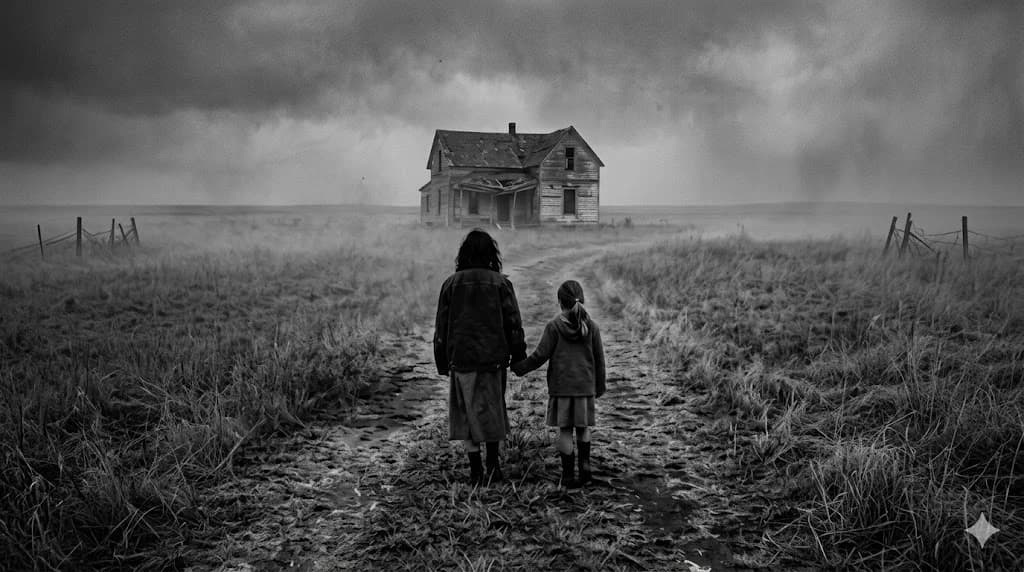
In the photo the sun does not illuminate. The only way to tell there is sunlight at all is the squinted eyes looking out from under the protective shield of one hand. Which is what one girl in the picture was doing, her other hand holding onto a younger child, their two bodies touching. Behind them an open field and the bulk of a two-story house. A low-hanging sky. The print faded, the words in the creases barely decipherable, but the story still revealing itself. May 7, 1952. Guthrie, Oklahoma. A troubled and violent family. An accident. The older sister, Amelia, watching over her sibling as they played outside, her attention diverted long enough for the younger child, Mona, to run out into the open road, killed instantly by a speeding car. Amelia, sent to a foster home.
On the floor by Carla’s bed, David sat and pondered the picture for a long time, trying to connect the dissipating threads. He peered at the image of Amelia, stared into his mother’s face, traced its evolution over the years.
* * *
P.O. Box 66 was playing in Woodville at a place called One Goat, a hole-in-the-wall dive bar. A pit of an establishment, popular with hardly anyone, frequented by locals who didn’t seem to know the difference. Most nights no one danced, and silence would have been a better outcome than the anemic ripple of applause. Ralph Castaneda, the corpulent proprietor, heaved his way like a slow-rolling tank and plunked his belly over the bar counter. He exchanged a few words with the bartender then lumbered off.
A straggle of old-timers hunched over the bar sipping the dregs of the night. Ralph Castaneda ensconced in the back office of the bar counting the evening’s returns. Ten more minutes of contractual play time, and so the band transitioned to a slower tempo, Walking in Memphis, with its soft, double-time snare and rim play, inflected at the end of every measure with a two beat kick. And then there it was, hoisting itself onto that lonesome melody and the throbbing beat off David’s kick drum. Tripping up David’s rhythm with an overwhelming surge of hurt and loss. The feel of Carla’s heart against his chest as they lay on the porch. The beating of her heart against him like a pulse of memory from a long bus ride across barren space. Cradled in her arms.